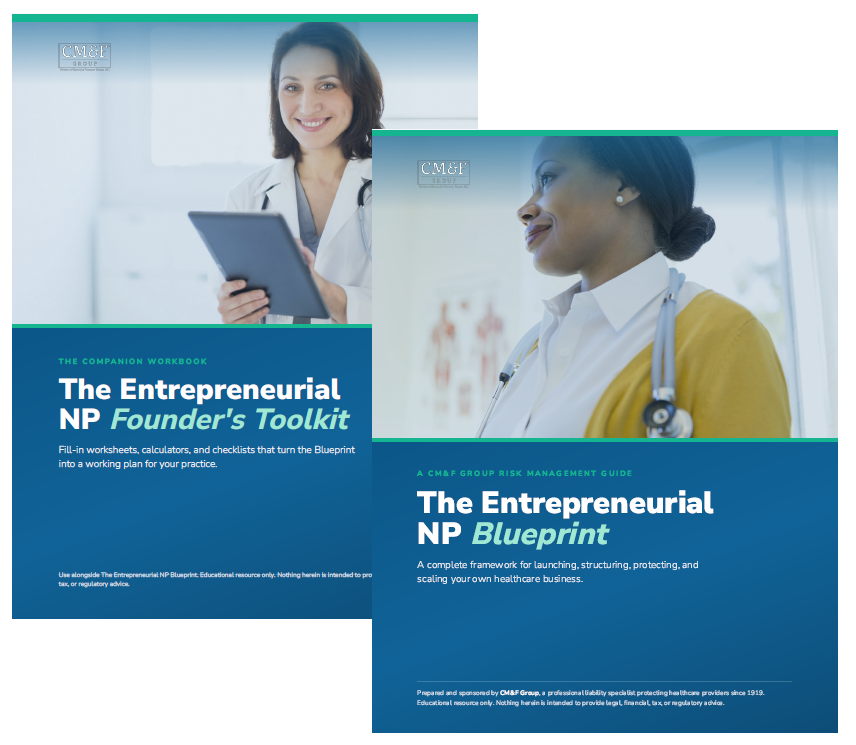
Starting your own NP practice means turning your clinical expertise into a business: choosing a practice model, forming a legal entity, meeting your state’s practice authority and ownership rules, securing the right malpractice and business insurance, financing your launch, and building the systems to run it day to day. More nurse practitioners than ever are opening cash-based clinics, specialty practices, and NP-owned businesses, yet clinical training rarely covers the legal, financial, and risk side of ownership. The Entrepreneurial NP Blueprint and its companion Founder’s Toolkit give you a step-by-step framework for every stage, from validating your idea to opening your doors, with a risk insight at each step.
Fill out the form below to receive your copy.
Your Complete Guide to Launching an NP-Owned Practice
What You’ll Learn About Starting an NP Practice
Inside the Entrepreneurial NP Blueprint and its companion Founder’s Toolkit, you’ll get a step-by-step framework for turning your clinical expertise into a practice you own, including:
- How to choose the right practice model for your goals, from cash-based and mobile to specialty and full-service, and how to test demand before you invest.
- The business-structure and formation decisions that set your practice up correctly and help protect your personal assets.
- What your state’s practice authority and ownership rules mean for an NP-owned practice, and the questions to bring to your attorney.
- How to layer professional liability and business coverage so both you and your practice are protected.
- How to estimate your startup costs and the weekly visit volume you need to break even, using the included calculator.
- The operational and HIPAA-compliance systems to put in place before you open your doors.
- How to market your new practice and bring in your first patients.
Plus a fillable Founder’s Toolkit with worksheets, a niche scorecard, and a working startup-cost and break-even calculator.
Frequently Asked Questions
Can a nurse practitioner own their own practice?
In many states, yes, though the rules vary. Some states let NPs own a practice outright, while others limit ownership or require a specific business structure because of corporate practice of medicine rules. Confirm your state’s ownership and practice authority requirements with a healthcare attorney before you form your entity.
How do you start an NP practice?
Starting an NP practice means moving through a few key stages: choosing your model, forming your business, meeting your state’s practice authority and ownership rules, getting properly insured, planning your finances, setting up operations, and opening. The Entrepreneurial NP Blueprint walks through each stage in detail, with a risk insight at every step.
How much does it cost to start an NP practice?
Startup costs vary widely by model and location. A cash-based or mobile practice can launch with relatively little, while a full brick-and-mortar clinic requires leasehold improvements, equipment, licensing, insurance, marketing, and several months of working capital. The Founder’s Toolkit includes a startup-cost and break-even calculator to estimate your specific numbers.
Do you need malpractice insurance to start an NP practice?
Yes. Professional liability (malpractice) insurance is essential for any NP-owned practice, and most facilities, collaborating physicians where required, and payers require it. As an owner you may also need a Business Owner’s Policy, cyber liability, and workers’ compensation. CM&F’s coverage for NPs starts at $1M/$3M per-claim and aggregate limits, with additional options based on your practice.
Can a nurse practitioner practice independently?
It depends on the state. Many states grant NPs full practice authority to evaluate, diagnose, and prescribe independently, while others require a collaborative or supervisory agreement (reduced or restricted practice). Your practice structure and documentation should reflect your state’s current practice authority rules, which a healthcare attorney can confirm.